

Tech's She-conomy: Why Meta’s Next Era Depends Entirely on Female Adoption
Reviewing the predictive framework that anticipated the shift toward utility-led fashion
Technology and fashion are both trying to tackle the same crisis at the moment— the general public is sick of them.
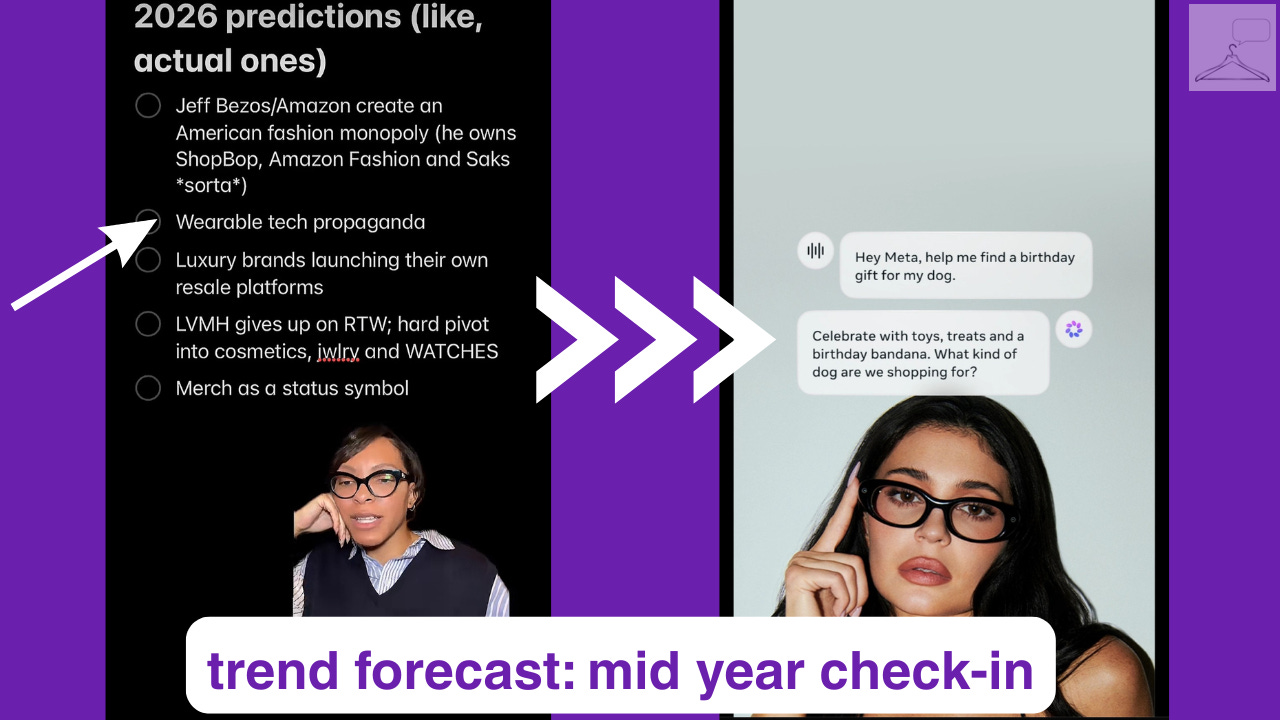
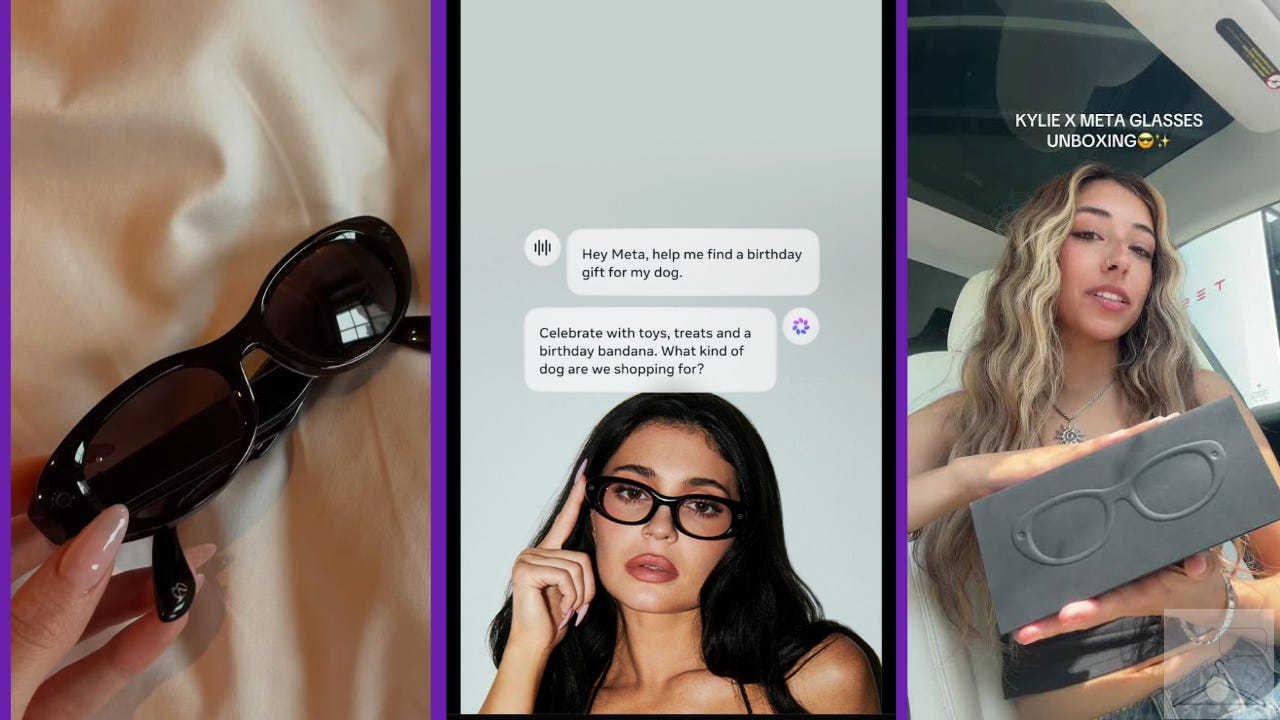
We said as much in 2023 when we coined the term ‘the new luxury will be your life’. And as we entered into 2026, we forecasted that this would be a big year for wearable tech marketing. Now halfway through the year, Meta has launched a full scale partnership with one of the most public female figures in pop culture, Kylie Jenner.
With regards to fashion, we saw this writing on the wall as we were approaching the 2020s. I personally decided to make a career pivot out of full time corporate fashion in Q4 of 2019 because all signs pointed to the fact that this was about to be an industry in flux, to say the very least. For one, the rise of fast fashion made it so that an entirely new generation of people regarded clothing and accessories as cheap and expendable; that wouldn’t bode well for the future. For two, ubiquity is the kryptonite of luxury. Luxury fashion started to operate and produce like it was a commodity, with very shortsighted growth plays. I saw that soon enough, the over saturation would taint the perceived value, which would lead to lost sales. Of course, I could not have foreseen COVID, which accelerated the timeline of how long I thought it would take for public sentiments around luxury to change.
With regards to tech, I saw the first seismic shift in public perception when news broke about the Cambridge Analytica scandal. It was the first time many people stopped to consider if technology/social media was trying to influence the way they think. For the most part up until this point, Big Tech could still count on a large amount of good press to stomp out the occasional exposé about data breaches or employee whistleblowers. But once people were made aware of Big Tech’s hand in manipulating their choices, it gave many people great pause to reconsider their relationship to technology and if it should be further removed. Fast forward to today and we have people deliberately using older tech, limiting time spent on social media and doing all manner of things to live an ‘analog’ life.
That’s why we knew 2026 was going to be a year with a huge push for wearable tech products.
Consider 3 main reasons why these industries are incentivized to push wearable adoption:
Meta has put too much investment in virtual reality (VR) to abandon the technology for it altogether.
Meta has poured far too much capital, infrastructure, and institutional pride into spatial computing to simply walk away from virtual reality. But the traditional headset model has hit a consumer ceiling. The Ray-Ban smart glasses aren't an abandonment of their broader metaverse thesis; they are a necessary, Trojan-horse pivot. To keep the long-term VR roadmap alive, Meta had to find a way to make wearable AI culturally palatable today—stepping out of the immersive digital world and onto the physical face.
The only way to achieve mass adoption and profitability is to embrace the female TAM.
Silicon Valley has a historical blind spot: it builds hardware for processing power, not for daily life. But specs don’t drive mass-market margins; lifestyle integration does. The reality is that consumer tech hardware remains a niche, low-margin dead end until it captures the female Total Addressable Market (TAM). Meta’s breakthrough happened the exact moment they stopped treating wearable tech as a gadget for the tech-adjacent male demographic and started engineering it as a core accessory for the modern woman’s wardrobe.
As luxury goods lose their cultural cache, integration of lifestyle products is crucial for P&L.
As the traditional luxury goods sector faces deep systemic headwinds and struggles to reconnect with a consumer base that has largely abandoned aspirational pricing, legacy fashion houses are facing a critical P&L crisis. Enter the hardware licensing play. For brands like Ray-Ban, Gentle Monster, and legacy luxury houses, partnering with big tech to build connected wearables isn't an experimental novelty—it’s a margin-stabilization strategy.
Big Tech is learning in real time that being in the CPG business is harder than it looks. Outside of early (mostly male) adopters, the playbook for how to bring new products to market is entirely different. Meta clearly did not know what people’s incentives were when they created the Metaverse. They went all in on a world that spoke to a very small subset of people and gave no regard to how to incentivize other groups (read: women) to join the community. Though battling a different problem, luxury fashion failed at its communications with women too. It lost respect for the customers’ discretionary income, and became complacent with messaging until it affected revenue.
A lot is riding on wearable tech bringing women back into the fold, but since you’ve been keeping up with our trend reporting, you knew that already. The real question for us since we are 2 steps ahead of the curve is, “what comes next?”
Want to know what’s next in business and how to AI proof your product?
I partner with select consumer brands to audit data architecture and trend forecasts. If you're looking to future-proof your brand's next quarter, you can get in touch at hello@thoughtfulthreads.co
Enjoying the Thoughtful Threads newsletter? Please consider the following:
Giving this post a 💜 and sharing it with any other branding aficionados you know!
Joining this community as a paid subscriber which helps support my work for less than a large coffee (or a one time coffee treat is fine!)
Sharing any interesting info/topics of interest/pictures of your furbabies to hello@thoughtfulthreads.co
Disclaimer
Some of the links in this newsletter may be affiliate links. This means that if you make a purchase through these links, I may earn a small commission at no additional cost to you. I only recommend products or services that I personally believe will add value to my subscribers. Your support helps keep this newsletter running and allows me to continue providing valuable content. Thank you for your support!